We install artificial turf. We also install natural grass lawns, maintain them on monthly plans, and restore lawns that have been destroyed by moss, dogs, and shade. We do all of it. So when a homeowner tells us they heard turf smells, or melts, or looks like a mini-golf course, we have no financial incentive to argue. If turf is not right for them, they become a lawn care client instead.
With that said, most of the concerns homeowners bring to us about artificial turf fall into two categories: things that were true 15 years ago and are not true anymore, and things that are true but only matter if the turf was installed badly. A few concerns are genuinely valid, and we will tell you which ones those are.
Here are the seven things Seattle homeowners most commonly get wrong about artificial turf, what is actually true, and what you should actually be worried about instead.
Myth 1: Artificial Turf Smells Bad with Dogs
This is the number one concern we hear, and it is the one with the most nuance. The short answer: no, properly installed pet turf does not smell. Improperly installed pet turf absolutely does.
When a dog urinates on artificial turf, the liquid needs to go somewhere. In a properly engineered installation, it passes through a permeable turf backing, filters through the crushed rock base, and drains away through micro-perforated drainage pipes. The urine leaves the system. Nothing sits. Nothing ferments. Nothing smells.
In a cheap installation, the turf sits on sand or compacted dirt. Urine seeps through slowly, collects in the sand, and bacterial decomposition produces ammonia. On a warm day, that ammonia rises through the turf and you get the smell that everyone warns you about. It is real. And it is entirely a function of how the turf was installed, not a property of the turf itself.
Crushed rock base instead of sand or dirt. Rock does not absorb urine. Sand does. That is the single biggest difference between a pet turf system that smells and one that does not.
Permeable turf backing that drains at 30+ inches per hour. Standard turf with hole-punched backing drains much slower.
Antimicrobial infill. Zeolite-based infill absorbs ammonia and inhibits bacterial growth between rinses.
Periodic rinsing. During dry weather, hosing pet areas 2 to 3 times per week and applying enzymatic cleaner monthly keeps bacteria from building up.
The Bottom Line on Smell
Turf smell is an installation problem, not a turf problem. If a company quotes you a pet turf installation on a sand base without drainage pipes, you will have odor within months. Ask every installer: what is your base material, what is your drainage system, and what is your infill?
This one is true — partly. And it matters a lot less in Seattle than it does in Phoenix.
Synthetic turf absorbs heat. On a direct-sun, 90-degree day, the surface temperature can be 20 to 40 degrees warmer than natural grass. In Arizona, that means surfaces can reach 150+ degrees and genuinely burn bare feet. In Seattle, we get about 15 to 20 days per year above 80 degrees. The turf gets warm on those days, the same way a deck or patio gets warm. A quick spray with a garden hose drops the surface temperature by 30 to 40 degrees in seconds.
The specific scenario where turf heat is a real consideration in Seattle: full south-facing exposure with no shade on a large area intended for barefoot use by small children during peak summer afternoons. For everything else — pet runs in partial shade, backyards under tree canopies, north-facing areas, or any installation where primary use is mornings and evenings — heat is a non-issue in this climate.
The Bottom Line on Heat
In Seattle, artificial turf heat is a footnote, not a dealbreaker. If your installation is in full sun and barefoot kids will be playing at peak afternoon heat, consider heat-reflective turf products or a shade structure. For every other application in our climate, this concern is overblown.
Myth 3: Artificial Turf Looks Fake
Some does. The cheap stuff looks terrible. Single-color, uniform-height, shiny blades with no variation. It looks like what it is: plastic trying to be grass.
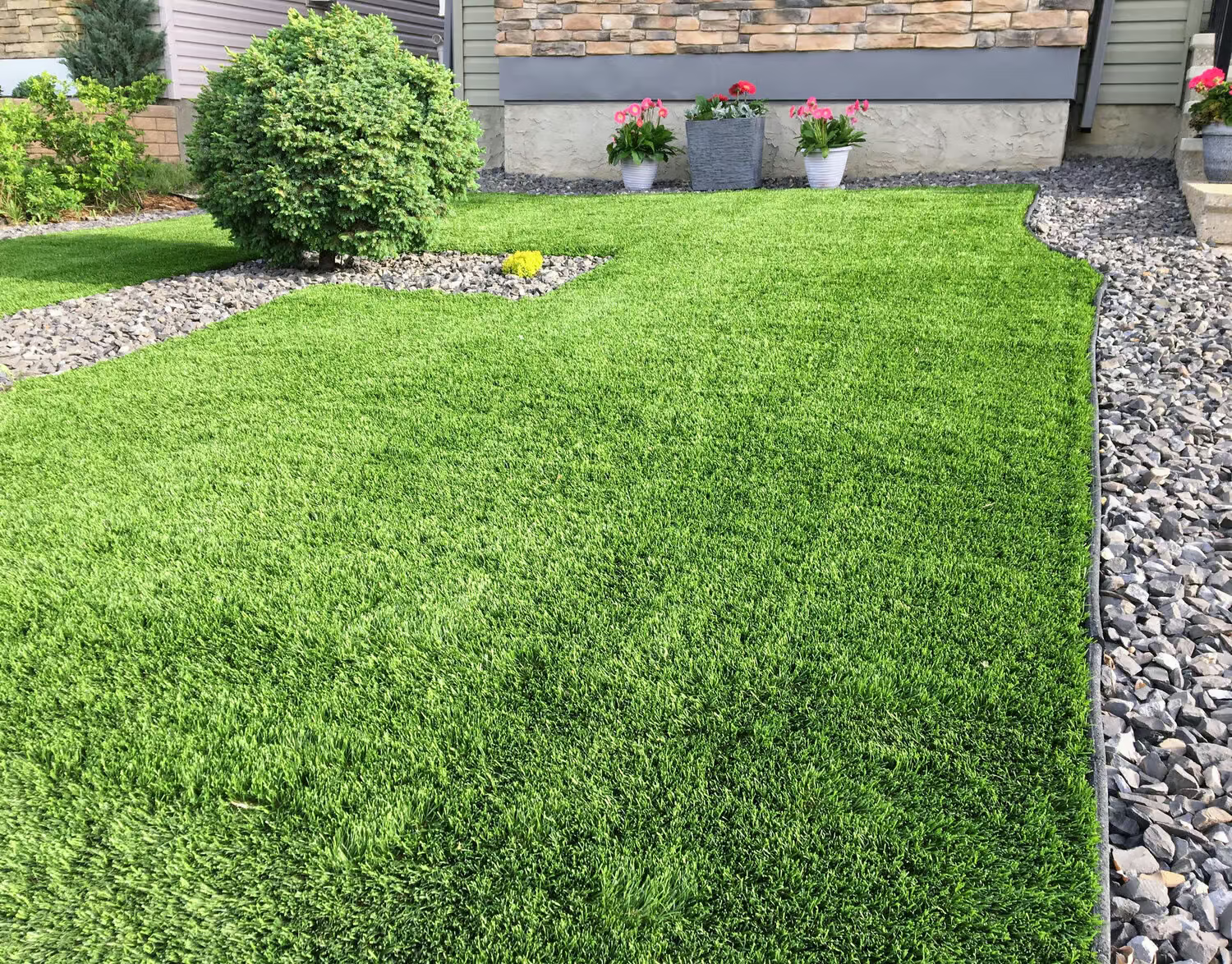
Modern premium turf is a completely different product. Multiple fiber colors in each roll — field green, olive, dark green, lime, and brown thatch fibers mixed together to replicate the natural color variation of a real Pacific Northwest lawn. Variable blade heights. Matte finish instead of gloss. A realistic thatch layer at the base that mimics dead grass. From the sidewalk or anywhere beyond about 5 feet, quality turf is nearly indistinguishable from a well-maintained natural lawn.
Face weight determines realism. Higher face weight (60 to 80 ounces per square yard) means denser, fuller blades. Budget products at 40 to 50 ounces look sparse and flat.
Color blending matters. Multi-tone products with 3 to 4 colors look natural. Single-color products look like astroturf from the 1990s.
Thatch layer adds depth. A built-in brown thatch layer at the base mimics dead grass and adds realism. Without it, turf looks too perfect.
Blade shape affects sheen. S-shaped and W-shaped blades reflect light differently than flat blades, reducing the artificial sheen that gives cheap turf away.
Want to see premium turf products in person?
We bring samples to every site visit. Free estimate with no obligation.
This is a legitimate concern that deserves a serious answer, not a dismissive one.
The safety conversation centers on infill — the material brushed into the fibers to support the blades. The old standard was crumb rubber, made from recycled tires. Crumb rubber has been the subject of ongoing research regarding potential chemical exposure, especially for children. Some municipalities have restricted or banned crumb rubber on new installations.
Here is the real kicker: you do not have to use crumb rubber. It is not the only option. Any installer who tells you crumb rubber is the standard for residential installations in 2026 is behind the curve.
We use rounded silica-free sand and zeolite-based infill. Zeolite is a natural mineral that absorbs ammonia, inhibits bacteria, and does not contain the chemical compounds that raised concerns about crumb rubber. For playground installations, we use infill products certified for direct skin contact that do not carry California Proposition 65 warnings. We do not use crumb rubber. We do not use crystalline silica sand.
The Infill Question
Before signing any turf contract, ask: what infill do you use, and can I see the safety data sheet? A reputable installer will answer immediately. If the answer is crumb rubber, ask for an alternative. If they cannot offer one, find a different installer.
Myth 5: Artificial Turf Is Zero Maintenance
No. Artificial turf is low maintenance — approximately 90% less work than natural grass. But it is not zero.
Brushing: High-traffic areas flatten blades over time. A stiff-bristle broom every few months keeps them upright. Takes 10 minutes.
Debris removal: If you have trees, you still need to blow or rake leaves off the turf. Organic debris sitting on the surface can sprout surface weeds.
Pet area rinsing: Hosing the pet zone 2 to 3 times per week during dry weather keeps odor-causing bacteria from accumulating. During Seattle's rainy season, nature handles this.
Enzymatic cleaner: Monthly application on pet areas breaks down residual bacteria. Spray, wait 15 minutes, rinse. Five minutes of effort.
Infill top-up: Check high-traffic areas every 1 to 2 years. Infill can shift or compact in heavily used zones.
Total time commitment: roughly 30 minutes per month for a pet installation. Less for a no-pet installation. Compare that to 4 to 8 hours per week for a natural lawn during growing season.
The Bottom Line on Maintenance
Homeowners who install turf expecting to never touch the yard again end up with matted blades, debris buildup, and pet odor issues 2 to 3 years in. A small amount of regular care keeps turf performing and looking good for its full 15 to 20 year lifespan.
Myth 6: Artificial Turf Does Not Drain in Seattle Rain
This is the question that should matter most to anyone in the Pacific Northwest, and it is the one most turf articles written for national audiences completely ignore. Seattle gets 37+ inches of rain per year. It rains 150+ days. If turf cannot drain rapidly, it becomes a swamp.
A properly installed turf system in Seattle drains faster than natural soil. Our base system uses 3 to 4 inches of clean crushed rock compacted to 95%+ density. Water passes through the turf backing, through the rock, and into the subsoil. Permeable backing on the turf itself drains at 30+ inches per hour. The heaviest Seattle rainstorms deliver about 1 to 2 inches per hour at peak intensity. The turf drains 15 to 30 times faster than the hardest rain.
Natural soil in Seattle — particularly the clay-heavy glacial till that most Kirkland, Bellevue, and Seattle properties sit on — drains at roughly 0.5 to 2 inches per hour. Turf on a proper base literally drains faster than the lawn it replaced.
Myth 7: Artificial Turf Is Environmentally Neutral
This is the one concern where neither side gets to claim a clean win. And we are not going to pretend otherwise.
What artificial turf eliminates: Water consumption, gas-powered mowing emissions, fertilizer and herbicide runoff into the storm system, and pesticide use for grub and weed control. All of these go to zero with turf.
What artificial turf introduces: Petroleum-based plastic manufacturing, non-biodegradable product at end of life, loss of the living soil ecosystem, and potential microplastic shedding over the turf's lifespan (though the extent of this in residential settings is still being studied).
Where this lands for Seattle homeowners: if your natural lawn is maintained with minimal chemicals, irrigated efficiently, and mowed with an electric mower, it has a genuine environmental advantage over turf. If your natural lawn requires heavy chemical inputs, extensive gas-powered mowing, and thousands of gallons of summer irrigation to survive — and still ends up as 50% moss every winter — the environmental math shifts.
The Honest Answer
If environmental impact is your top priority, the best option for a chronically failing lawn is not turf. It is native ground cover, rain garden, or mulch beds with native plantings. These options support the local ecosystem without the resource demands of natural grass or the plastic footprint of synthetic turf. Turf is the low-maintenance option. Native conversion is the low-impact option. They are not the same thing.
Low-E windows can melt artificial turf. Energy-efficient Low-E windows — standard on most Seattle homes built or remodeled after 2000 — can reflect and concentrate sunlight like a magnifying glass. If the reflected beam hits the same spot on your turf consistently, it generates enough heat to melt, warp, or permanently discolor the fibers. We check window angles and sun exposure during every site visit. If reflective windows face the turf area, exterior window screens or film prevent the problem entirely. This must be identified before installation, not after.
Cheap installation fails within 2 years. The difference between an $8/sq ft installation and a $14/sq ft installation is not the turf. It is the base. Companies that skip proper excavation, use sand instead of crushed rock, or omit drainage engineering produce installations that wrinkle, sink, hold water, and develop odor within 12 to 24 months. The base is 60% of the cost and 90% of the quality.
End-of-life is a real cost. Artificial turf lasts 15 to 20 years. After that, the surface needs replacement. The base system remains, so replacement costs roughly $4 to $8 per square foot — not the full installation amount. But it is not zero. If you are doing a 20-year cost analysis, include this number.
Honest Answers About Artificial Turf. We Install Both Options and Tell You Which One Fits.
Free site assessment with product samples. No pressure, no obligation.
Frequently Asked Questions About Artificial Turf in Seattle
Does artificial turf smell with dogs? +
Not when installed with a proper drainage system. Odor is caused by urine collecting in sand or dirt bases. Crushed rock bases, permeable turf backing, drainage pipes, and antimicrobial infill prevent urine from sitting in the system. Regular rinsing during dry weather and monthly enzymatic cleaner application maintain freshness.
Does artificial turf get hot in Seattle? +
Turf can feel warm on hot sunny days. Seattle gets about 15 to 20 days per year above 80 degrees. On those days, the surface is comparable to a deck or patio. A garden hose rinse cools it immediately. In shaded installations, heat is not a factor. For most Seattle homeowners, this is a minor consideration, not a dealbreaker.
Does artificial turf look fake? +
Budget single-color products look obviously artificial. Premium multi-tone products with thatch layers and variable blade heights are nearly indistinguishable from natural grass at normal viewing distances. Product quality and face weight determine realism.
Is artificial turf safe for children? +
Yes, when installed with safe infill. We use silica-free sand and zeolite-based infill that does not contain crumb rubber, crystalline silica dust, or Proposition 65 chemicals. For playground installations, we add foam padding for fall protection. Ask any installer what infill they use and request the safety data sheet.
Is artificial turf really zero maintenance? +
No. It is low maintenance: approximately 90% less work than natural grass. Ongoing care includes periodic brushing, debris removal, pet area rinsing, and occasional infill top-up. Total time commitment is roughly 30 minutes per month for pet installations.
Does artificial turf drain in Seattle rain? +
Properly installed turf on a crushed rock base drains at 30+ inches per hour, which is 15 to 30 times faster than the heaviest Seattle rainstorms. Turf on a proper base actually drains faster than the natural clay soil it replaced.
Can energy-efficient windows damage artificial turf? +
Yes. Low-E double-pane windows can concentrate reflected sunlight enough to melt turf fibers. We assess window angles during every site visit and recommend screens or film if reflective windows face the turf area. This is preventable but must be identified before installation.
Is artificial turf bad for the environment? +
It eliminates water use, mowing emissions, and chemical runoff. But it introduces petroleum-based plastics, end-of-life disposal challenges, and loss of living soil ecosystems. Neither turf nor natural grass is perfectly green. The environmental impact depends on your specific situation and which tradeoffs matter to you.
How long does artificial turf last in Seattle? +
Quality turf on a proper base lasts 15 to 20 years. UV stabilization prevents fading. The base system lasts longer than the turf, so replacement involves only the surface layer at reduced cost.
Does artificial turf attract pests? +
No. The inorganic crushed rock base does not support insects, grubs, or rodents. Natural lawns attract crane flies, leatherjackets, and moles. Turf eliminates all of these. Occasional surface ants may explore the warm turf but do not nest in the base system.
Can weeds grow through artificial turf? +
Very rarely. The geotextile weed barrier, crushed rock base, and turf itself create three layers weeds cannot penetrate from below. Occasionally, wind-blown seeds germinate in surface debris. They pull out easily because they have no root structure. Keeping the surface clear of organic debris prevents this entirely.
Does artificial turf lower property value? +
Context dependent. A quality turf installation replacing a chronically failing lawn typically improves curb appeal and property value. A front-yard turf installation that looks out of place in a neighborhood of natural lawns may reduce appeal. Backyards, pet areas, and side yards are almost always value-neutral or value-positive.
Can I install artificial turf on a slope? +
Yes. We install turf on slopes regularly in Seattle and Kirkland. Steeper grades require additional anchoring and drainage channels cut into the slope to prevent water from running under the turf. We assess slope angle during the site visit.
What happens to artificial turf after 15 to 20 years? +
The turf surface is removed and replaced. The crushed rock base system remains in place because it does not degrade. Surface-only replacement costs roughly $4 to $8 per square foot, less than the original installation. Recycling options for used turf are limited but growing.
How do I know if artificial turf is right for my Seattle yard? +
Start with a site assessment. We evaluate sun exposure, shade, drainage, soil condition, slope, pet use, and your maintenance tolerance. If turf is the right answer, we explain why. If it is not, we recommend lawn restoration or ground cover conversion instead. The assessment is free and takes about 20 minutes.
The Concerns Are Understandable. Most of Them Are Solvable.
Artificial turf has real limitations. It is not a living surface. It requires a proper base to drain. It needs occasional care. It has an end-of-life cost. And it can be melted by your own windows if nobody checks before installation.
But the things that scare most homeowners away from turf — the smell, the heat, the fake look, the safety concerns — are either outdated information or problems that only exist in cheap installations. Modern turf on a proper base, with the right infill, installed by someone who knows what they are doing in this climate, performs exactly as advertised.