July 26, 2026
Seattle Soil: Why Your Plants Are Struggling and How to Fix the Dirt Beneath Them
Growing up in Kirkland taught us the soil, the seasons, and what holds. We build what lasts here because we live here. That matters.
Most gardening advice assumes you start with decent soil. In Seattle, that assumption is wrong. The soil under your yard was deposited by glaciers 15,000 years ago. It has been leached by 38 inches of annual rainfall for millennia. And if your home was built in the last 20 years, the topsoil was probably scraped off during construction and replaced with whatever subsoil was at the bottom of the excavation pit.
You can plant the most expensive Japanese maple in the Pacific Northwest, and it will struggle if the soil cannot drain, cannot hold nutrients, or has a pH that locks out the minerals the tree needs. Every landscape problem that looks like a plant problem is often a soil problem.
This article covers the science of Seattle soil: what you are working with geologically, why it behaves the way it does chemically, and what amendments actually change the conditions rather than temporarily masking them. It also covers mulching, sheet mulching for reclaiming overgrown areas, and why your lawn turning brown in January is biology working correctly, not failure.
What Seattle Soil Actually Is (Glacial Till and Acid Rain)
Glacial Till: The Clay Legacy
During the last ice age (the Vashon Glaciation, roughly 15,000 years ago), a mile-thick ice sheet covered the Puget Sound lowland. As the glacier advanced and retreated, it ground bedrock into fine particles and deposited a dense layer of clay, silt, and rock called glacial till. This till is the parent material of most residential soil in Seattle, Kirkland, Bellevue, and the Eastside.
Why clay is difficult: Clay particles are flat and plate-like, and when wet, they stack together like wet playing cards. This tight packing prevents water from draining (it sits on the surface instead of percolating through), prevents air from reaching roots (roots need oxygen as much as water), and makes the soil extremely hard when dry and slippery when wet.
The sand myth: A common recommendation is to 'add sand to clay soil to improve drainage.' Do not do this. Sand particles are much larger than clay particles. When you mix a small amount of sand into clay, the clay fills the spaces between the sand grains, creating a material that is denser than either one alone — something resembling low-grade concrete. To actually change clay soil texture with sand, you would need to add sand at a ratio of roughly 4:1 (sand to clay), which means essentially replacing the soil entirely.
Acid Rain Leaching: Why Soil pH Drops Over Time
Rainfall in the Pacific Northwest is slightly acidic (pH 5.0 to 5.5) due to dissolved carbon dioxide forming carbonic acid. This is natural and unrelated to pollution. Over time, this acidic rain leaches calcium and magnesium (the minerals that keep soil neutral) out of the upper soil layers and carries them deeper into the ground, beyond the reach of most plant roots.
The result: Seattle soil trends toward pH 5.0 to 5.5 without intervention. Most ornamental plants, vegetables, and turf grasses perform best at pH 6.0 to 7.0. At low pH, key nutrients (particularly phosphorus, calcium, and magnesium) become chemically bound to soil particles in forms that plant roots cannot absorb. You can apply fertilizer to acidic soil and see little improvement because the nutrients are present but locked up.
The exception: Some plants thrive in acidic soil: rhododendrons, azaleas, blueberries, camellias, and native conifers evolved in these conditions. If your garden is primarily acid-loving plants, your native pH may be an advantage. This is why soil testing matters before you amend.

The Urban Fill Problem (New Construction)
If your home was built in the last 15 to 20 years (townhouses in Ballard, new developments in Bothell, rebuilds in Bellevue), you may not have natural soil at all. You have urban fill.
What happens during construction: Developers excavate the building site, removing the top 2 to 3 feet of soil (which contains the organic matter, the biology, and the structure that plants need). They build the foundation. When construction is complete, they backfill the yard with whatever subsoil was at the bottom of the excavation: rocky, compacted, biologically dead clay with no organic matter. A thin layer of topsoil (sometimes as little as 2 inches) is spread on top, sod is rolled over it, and the landscaping is declared 'complete.'
What you experience: Water pools on the surface because the compacted fill below does not drain. Grass roots hit a wall of dead clay 2 inches down and cannot grow deeper. Plants die within 6 to 12 months because there is no soil biology to support them.
The fix: For garden beds, the most effective approach is removing the top 8 to 12 inches of fill and replacing it with a quality engineered soil blend (topsoil, compost, and amendments mixed to specification). For lawns, heavy topdressing with compost over multiple seasons combined with core aeration gradually builds a living soil layer on top of the fill. Neither approach is instant. Building real soil in urban fill takes 1 to 3 years of consistent amendment.
For bed preparation, soil replacement, and compost installation, see our Landscaping Services page.
Soil Testing: What to Test and Why
Adding amendments without testing is guessing. A $25 to $30 soil test from WSU Extension tells you exactly what your soil needs and what it does not need. Over-amending is as harmful as under-amending — excess lime raises pH too high for acid-loving plants, excess nitrogen causes weak growth and disease susceptibility.
pH: Determines whether nutrients are available to plants. Below 6.0 = add lime. Above 7.0 = add sulfur (rare in Seattle). Between 6.0 and 7.0 = leave it alone for most plants.
Organic matter percentage: Healthy garden soil contains 5% to 10% organic matter. Native Seattle soil often tests at 2% to 4%. Adding compost raises organic matter over time. This is the single most important number for long-term soil health.
Nutrient levels (N-P-K): Nitrogen (N) drives leaf growth. Phosphorus (P) drives root and flower development. Potassium (K) drives overall vigor and disease resistance. A soil test tells you which nutrients are deficient so you can target your amendments instead of applying a generic all-purpose fertilizer.
Cation Exchange Capacity (CEC): This measures the soil's ability to hold onto positively charged nutrients (calcium, magnesium, potassium) and release them to plant roots on demand. Think of CEC as the soil's battery capacity. Clay soil has naturally high CEC (holds nutrients well but also holds water too well). The goal is soil with moderate CEC, good drainage, and high organic matter. Compost and biochar both increase CEC.
WSU Extension offers mail-in soil test kits. Collect samples from multiple spots in the area you want to test (6–8 inches deep, mix together). Mail the sample with the form and $25–30 fee. Results arrive in 2–3 weeks with specific amendment recommendations for your soil. Order at soiltest.wsu.edu. This is the most cost-effective investment in your landscape.
Amendments That Change Soil Structure (Not Just Fertilizer)
Fertilizer feeds plants. Amendments fix soil. They are different things that serve different purposes. Fertilizer on bad soil is like vitamins on a broken bone. The amendments below change the physical and chemical structure of the soil itself.
Compost (The Foundation Amendment)
Compost is decomposed organic matter. When incorporated into soil or applied as a topdressing, it improves every soil property simultaneously: it opens clay structure (improves drainage), increases water retention in sandy soil, adds organic matter (feeds soil biology), increases CEC (nutrient-holding capacity), and provides slow-release nutrients as it continues to decompose.
How to use it: For new beds: mix 3 to 4 inches of compost into the top 8 to 12 inches of native soil. For existing beds: topdress with 2 to 3 inches and let rain and earthworms incorporate it naturally (no-till method). For lawns: topdress with 1/4 inch of fine screened compost after aeration.
Source matters: Use heat-treated compost from a commercial facility (like Cedar Grove in the Seattle area). Commercially composted material reaches temperatures of 130 to 160°F, which kills weed seeds, pathogens, and disease spores. Home compost rarely reaches these temperatures and may introduce more problems than it solves when used at scale.
Lime (Calcium Carbonate): Raising pH
Lime is not a fertilizer. It is a soil amendment that raises pH by adding calcium and neutralizing acidity. In Seattle, where rain continuously leaches calcium from the soil, periodic lime application is maintenance, not a one-time fix.
When to apply: If a soil test shows pH below 6.0, apply granular lime in January or February. Lime reacts slowly with soil chemistry (2 to 3 months for measurable change), so winter application ensures the soil is in the target range by spring growing season.
How much: Follow your soil test recommendation. As a general guideline, 50 pounds per 1,000 square feet raises pH by approximately 0.5 to 1.0 points in clay soil. Do not over-apply. Raising pH above 7.0 creates nutrient deficiencies for acid-loving plants.
Gypsum (Calcium Sulfate): Clay Structure Without pH Change
Gypsum is a specific solution for clay soil. It adds calcium (which causes clay particles to clump together into larger aggregates, a process called flocculation) without changing pH. This is important if your clay soil already has acceptable pH but still has drainage and compaction problems.
How flocculation works: Clay particles carry a negative electrical charge. They repel each other, staying dispersed in a smooth, dense mass. Calcium (from gypsum) carries a positive charge. It bridges between negatively charged clay particles, causing them to cluster into larger aggregates. These aggregates create pore space between them, allowing water and air to move through the soil.
Application: Spread 40 to 50 pounds per 1,000 square feet on the soil surface. Rain and irrigation wash the calcium ions into the clay layer. Results are gradual (months, not days) and require repeated application over 2 to 3 years for significant improvement in heavily compacted glacial till. Gypsum works best in combination with organic matter (compost) and physical aeration.
Biochar: The Long-Term Soil Investment
Biochar is charcoal produced by heating organic material (wood, agricultural waste) at high temperatures in the absence of oxygen (pyrolysis). The result is a porous carbon structure that resists decomposition and can persist in soil for hundreds to thousands of years.
Why it works: The microscopic pore structure of biochar acts like a coral reef in the soil. Beneficial bacteria, fungi, and other soil organisms colonize these pores, creating a permanent habitat that survives drought, flooding, and temperature extremes. Biochar also has high CEC (it holds nutrients and releases them to plant roots), improves water retention in sandy soil, and improves drainage in clay soil by creating stable aggregate structure.
The catch: Raw biochar is not immediately beneficial. Fresh biochar has empty pore sites that will initially adsorb nutrients FROM the soil (temporarily reducing nutrient availability). The solution is to 'charge' biochar before application by soaking it in compost tea, liquid fertilizer, or mixing it into finished compost for 2 to 4 weeks. Pre-charged biochar adds both the structural benefits and an immediate nutrient reservoir.
Application rate: 5 to 10% by volume mixed into the top 6 to 8 inches of soil, or blended with compost for topdressing. Biochar is available from specialty garden suppliers. For large-scale application, bulk delivery is more practical and cost-effective than bagged product.
Long-term value: Unlike compost (which decomposes and must be replenished annually), biochar is a permanent soil improvement. A single application continues to benefit soil structure and biology for decades. This makes it the most cost-effective amendment over a 10+ year horizon despite higher upfront cost.
Bio-Stimulants: Feeding the Soil Biology (Educational)
Beyond traditional NPK fertilization, a growing body of research supports using biological inputs that feed the soil microbiome rather than the plant directly. These products are particularly suited to the PNW because our cool, wet climate supports active soil biology for most of the year.
Kelp meal: Derived from seaweed, kelp meal provides micronutrients (iron, zinc, manganese), natural growth hormones (cytokinins), and carbohydrates that feed soil microbes. Applied in late winter (January to February), it activates soil biology so microorganisms are ready to support plant growth when temperatures rise in spring.
Fish hydrolysate: A cold-processed liquid fish product (different from fish emulsion, which is heat-processed and loses beneficial compounds). Fish hydrolysate provides amino acids, oils, and proteins that feed soil bacteria and fungi. It is a rapid microbial activator.
Humic and fulvic acids: These are organic carbon compounds extracted from leonardite or composted material. They act as chelators: they bind to nutrients in the soil and transport them to root surfaces in forms that are easier for plants to absorb — a delivery service that improves the efficiency of existing soil nutrients and applied fertilizers.
The bio-stimulant and fertilizer products described above are available at specialty garden centers for homeowner application. Commercial application of fertilizer products on client properties in Washington State requires a WSDA license. The information above is educational. LandscapingFactory does not apply fertilizer products commercially. If you want professional application of kelp meal, fish hydrolysate, humic acids, or other fertilizer products, contact a licensed landscape company with WSDA fertilizer applicator certification.
Sheet Mulching: Reclaiming Overgrown Areas Without Herbicide
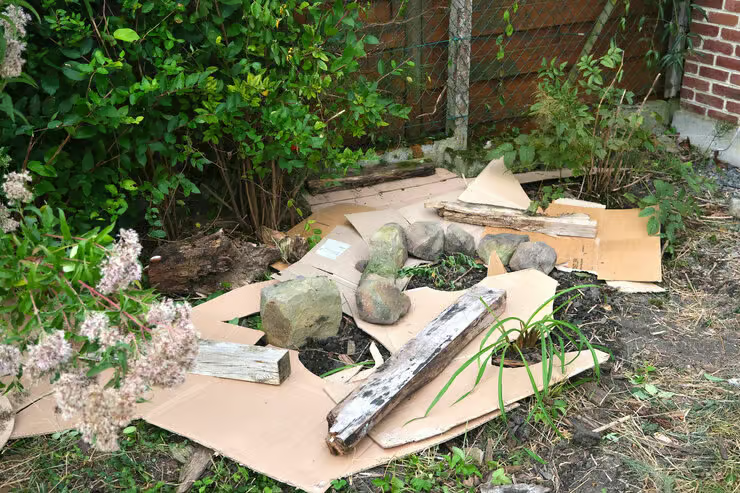
Sheet mulching (sometimes called the 'lasagna method') is a technique for converting weedy, overgrown, or lawn areas into garden beds without tilling, without herbicide, and without removing the existing vegetation. It smothers the existing plants in place and builds new soil on top of them.
The Process (Step by Step)
Cut or mow
Cut existing vegetation as short as possible. Leave the clippings in place. They become part of the organic layer.
Lay the barrier
Cover the entire area with overlapping sheets of plain cardboard (remove tape and staples) or thick kraft paper. Overlap edges by at least 6 inches so weeds cannot find gaps. The cardboard blocks all light from reaching the vegetation below.
Add compost
Spread 2 to 3 inches of finished compost on top of the cardboard. This is the planting layer and also weighs the cardboard down.
Add mulch
Cover the compost with 3 to 4 inches of arborist wood chips. This is the weed suppression and moisture retention layer.
Wait
Over 3 to 6 months, the vegetation below dies from light deprivation. The cardboard decomposes. Earthworms migrate upward through the layers, mixing compost with the native soil below. By the next growing season, you have a ready-to-plant bed with improved soil structure.
Best timing for Seattle: Fall (September to November) is ideal. The sheet mulch sits through the wet winter, giving maximum decomposition time. The bed is ready for spring planting. Winter application (January to February) also works but may need an additional month or two before planting.
What to avoid: Do not use glossy or coated cardboard (it does not decompose well). Do not use landscape fabric instead of cardboard (fabric does not decompose and creates long-term problems). Do not sheet mulch over invasive plants with deep root systems (like bindweed or horsetail) because they can grow through the barrier — these require manual grubbing first.
Sheet mulching, bed preparation, and compost installation are part of our landscaping services.
Sheet mulching, bed preparation, soil amendment, mulch installation.
We build the soil that supports everything else in your landscape. Free estimate.
Mulching: Why 3 Inches of Wood Chips Is the Best Investment in Your Garden
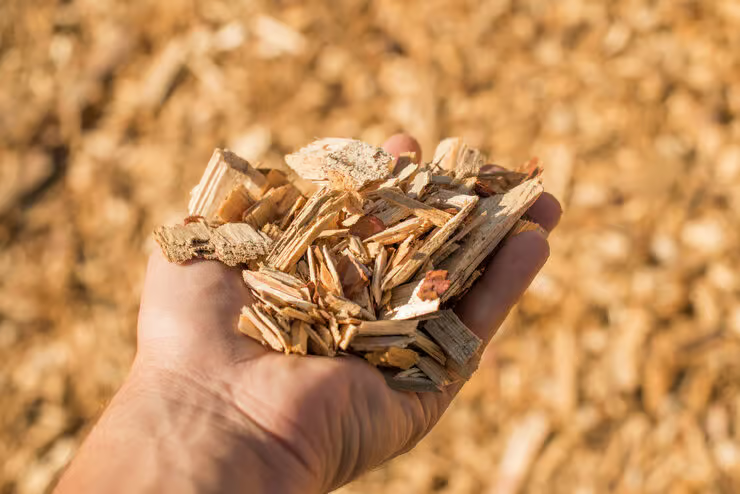
Mulching is the single most cost-effective soil maintenance practice and the most consistently undervalued by homeowners. A 3-inch layer of organic mulch on garden beds accomplishes four things simultaneously: it suppresses weeds by blocking light from reaching seeds, retains soil moisture by reducing evaporation (critical during Seattle's dry summers from July through September), insulates root zones against temperature swings, and feeds the soil as it decomposes at the bottom of the layer.
Which Mulch for Which Application
| Mulch Type | Best For | Advantages | Limitations |
|---|---|---|---|
| Arborist wood chips | Garden beds, around trees and shrubs | Slow decomposition feeds soil biology. Free or low-cost from tree services. Variable size adds natural texture. | Freshest chips temporarily draw nitrogen from soil surface (add nitrogen source underneath). Not ideal for vegetable beds. |
| Compost mulch | Garden beds, top-dressing lawns | Immediate soil biology boost. Dark, rich appearance. Breaks down fast and improves soil. | Decomposes quickly (needs annual replenishment). Less effective for weed suppression than wood chips. |
| Shredded bark | Pathways, slopes, shrub beds | Long-lasting. Stays in place on slopes better than chips. Clean, uniform appearance. | Does not improve soil biology as effectively as wood chips. Can mat down and repel water. |
| Bark nuggets | Decorative beds, low-traffic areas | Very long-lasting. Attractive. Low maintenance. | Floats away in heavy rain. Poor soil biology contribution. |
Depth: 3 inches for garden beds. 4 inches for weed-heavy areas. 2 inches maximum around perennials and shallow-rooted plants. Never more than 4 inches (suffocates roots and creates anaerobic conditions).
Trunk clearance: Keep mulch 3 to 4 inches away from tree trunks and shrub crowns. Mulch piled against bark traps moisture, promotes rot, and creates habitat for bark-boring insects. The root flare (where the trunk widens at ground level) must be visible and exposed to air.
Landscape fabric under mulch: No. Fabric under organic mulch in planting beds prevents earthworms from surfacing, stops mulch from decomposing into the soil (defeating its purpose), clogs with root growth and decomposed material within 2 to 3 years, and creates a barrier that must be removed when replanting. The only appropriate use of landscape fabric is under gravel paths or driveways where no plants will grow.
For mulch installation and annual replenishment, see our Landscaping Services page.
Lawn Dormancy: Your Lawn Is Not Dead, It Is Resting
Every January and February, Seattle homeowners see their lawns turn yellow or brown and assume something is wrong. In most cases, what they are seeing is dormancy: a natural survival mechanism of cool-season grasses.
What happens: Seattle lawns are typically perennial ryegrass and fine fescue blends. These are cool-season grasses that grow actively between 50°F and 75°F. When temperatures drop below 50°F and daylight hours shorten (November through February), the grass slows metabolic activity. The blades stop growing and may yellow. But the root system remains alive and active underground as long as the soil is not frozen (which is rare in Seattle).
The mistake: Seeing brown grass and applying high-nitrogen fertilizer to 'wake it up.' This forces the grass to use stored carbohydrate reserves in the roots to produce top growth during a period when the plant is trying to conserve energy. The result: the lawn greens up temporarily but enters spring with depleted root reserves and is weaker, thinner, and more disease-prone than a lawn that was allowed to rest.
What to do instead: Leave the lawn alone. Do not fertilize with nitrogen until the grass is actively growing (typically March in Seattle). If you want to support the root system during dormancy, soil amendments (lime if pH is low, compost topdressing) feed the soil without forcing top growth.
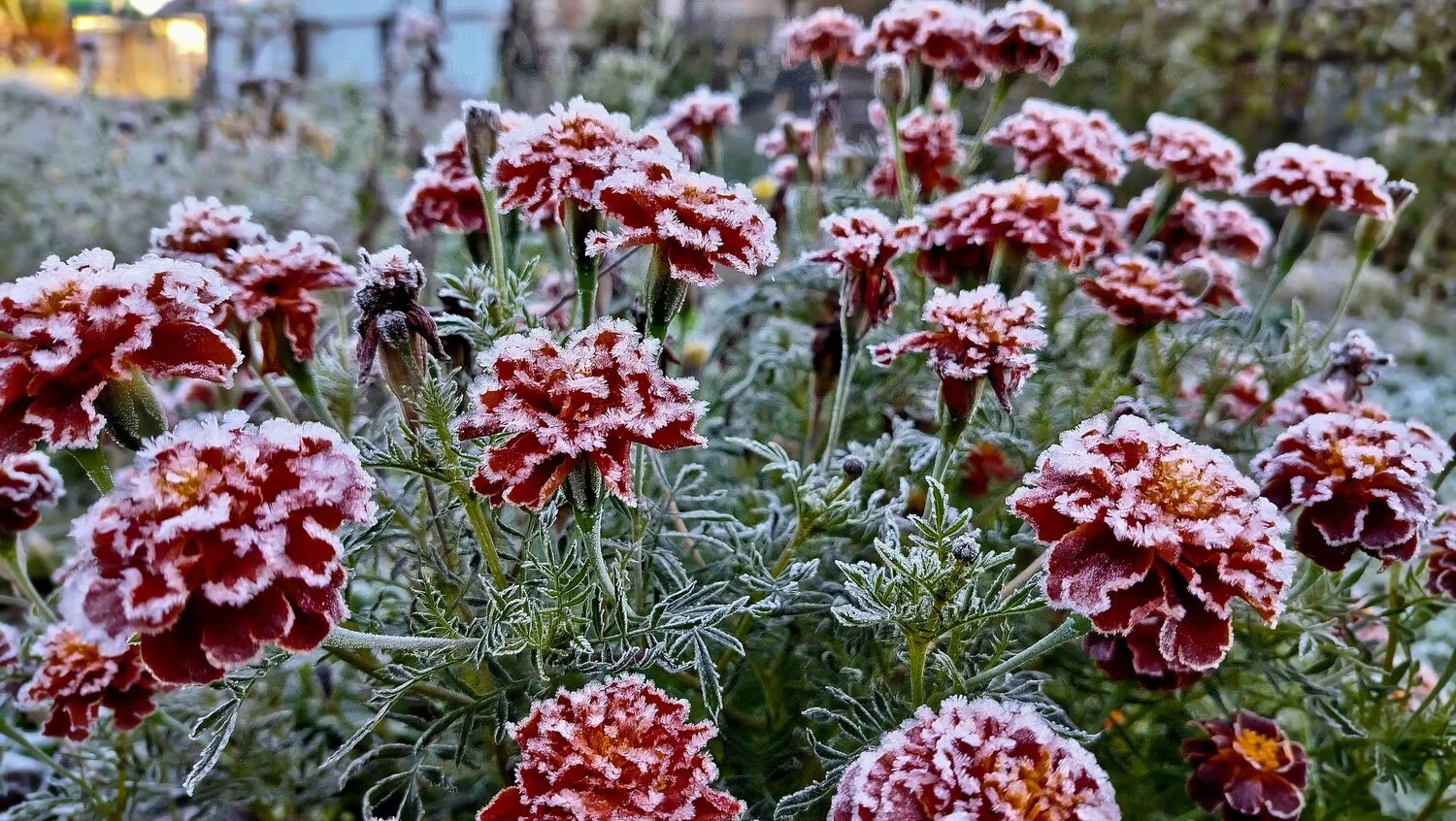
Traffic on dormant or frosted lawns: When grass is dormant or frosted, the blades are brittle and filled with ice crystals. Walking on frosted grass fractures the cellular structure. Within a few days, black footprint-shaped patches appear where the grass cells were crushed. During winter, avoid walking on the lawn when frost is visible. The damage is cosmetic (the grass regrows in spring) but unsightly and avoidable.
For lawn care programs that build root health year-round (aeration, overseeding, seasonal fertilization schedules), see our Lawn Care and Maintenance page.
Landscape Fabric: When to Use It and When to Avoid It
Landscape fabric is one of the most misused products in residential landscaping. Homeowners install it under mulch in garden beds expecting permanent weed suppression. What they get is a barrier that degrades the soil and creates maintenance headaches within 2 to 3 years.
What happens: Organic mulch on top of fabric decomposes into a thin layer of soil ON TOP of the fabric. Weed seeds land in this decomposed layer and germinate. Their roots grow through the fabric. Now you have weeds rooted through fabric, which is nearly impossible to pull cleanly. Meanwhile, the fabric prevents earthworms from reaching the surface and stops the mulch from feeding the soil below.
When fabric IS appropriate: Under gravel paths, gravel driveways, and decorative rock areas where no plants will grow and no organic mulch is used. In these applications, fabric prevents the gravel from sinking into the soil and suppresses weeds effectively because there is no decomposing organic layer on top to support new weed growth.
When fabric is NOT appropriate: Under organic mulch in any planting bed. Around trees and shrubs. In vegetable gardens. Anywhere you want soil biology to function. Use mulch alone (3 inches deep) for weed suppression in planted areas. It works better than fabric and feeds the soil simultaneously.
Frequently Asked Questions About Soil and Mulching in Seattle
What is the difference between topsoil and garden soil? +
Can I add sand to fix clay soil? +
What is the white mold on my mulch or soil? +
Should I till my garden beds every year? +
How do I make soil more acidic for blueberries? +
Can I put new soil on top of my lawn? +
What is loam? +
Why is my soil repelling water? +
Does mulch attract termites? +
Should I use landscape fabric under mulch? +
How often should I test my soil? +
Is bagged soil from hardware stores good enough? +
What is biochar and is it worth it? +
Why is my lawn brown in January? +
Can I use coffee grounds in the garden? +
Healthy Soil Is the Foundation. Everything Else Follows.
Every plant in your landscape depends on the soil beneath it. In Seattle, that soil starts with challenges: glacial clay that does not drain, acidic pH that locks nutrients away from roots, and (in newer homes) urban fill that has no biology at all. These are not problems you solve once. They are conditions you manage over time with consistent amendment, mulching, and care.
The return on soil investment is everything else in your garden: plants that establish faster, lawns that outcompete moss, beds that need less watering, and a landscape that becomes more resilient every year instead of more dependent on intervention.
Soil Amendment. Mulching. Sheet Mulching. Bed Preparation.
We build the soil that makes everything else in your landscape work. Free estimate.
Similar Posts
Contact Us Today For A Free Consultation
Let's get started.
Tell us what you'd like to tackle when you request a quote and we'll do the rest.